TEACHING PHILOSOPHY
My teaching philosophy—in the most abstract and theoretical sense—is informed by the radical force of writing to both affirm and disrupt the many preconceptions writers might have about their worlds, “this” world, and the world to come. I regard the experience writing as a kind of dispossession or suspension of selfhood whereby writers encounter and welcome the absolute other. In turn, this other—as character, as form, as text—hails readers and calls them to responsibility. In this way, then, to engage the other on its own terms requires sound reading practices and robust critical discernment as well as a willingness to surrender to the demands and pleasures of language.
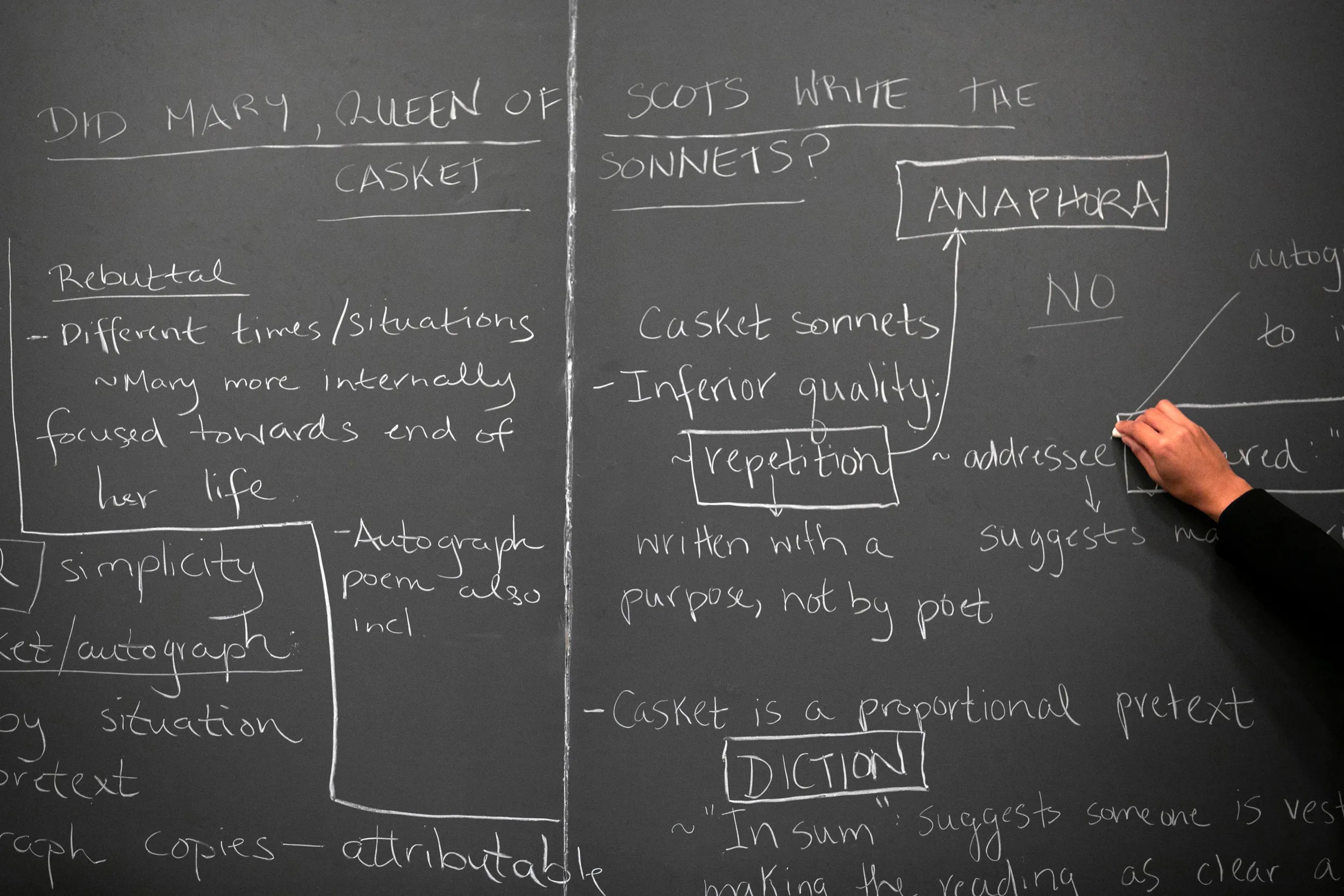
In a more concrete and practical sense, this responsibility begins when students encounter and engage the textual other through informal responses to questions about language. Before any in-depth analysis of a new reading assignment, I ask students to select a word, phrase, or line from an assigned text that they deem significant. Additionally, I require that they prepare a justification for their selection and be willing to lead the class through a brief discussion regarding how the selected term/phrase operates in the text as a whole. Not only does this disarm students’ anxiety as they attempt to manage and understand the text for the first time. It also provides students with a strategy of engagement that furnishes them with some control and agency over their reading. Moreover, I record their terms and phrases on the classroom board and strive to help students make connections between the various concepts and ideas resulting from their presentations. This exercise has the added benefit of creating a welcoming, hospitable learning environment, one wherein students learn collaboratively rather apart.
By designing activities such as this one, I remain attentive to the fact that students enter the classroom with diverse levels of preparation, linguistic backgrounds, and cultural experiences. Beginning with a single word or phrase ensures that every student has an accessible entry point into the text, one that validates their perspective and invites them into the larger conversation. Some may choose a word because of its sound, rhythm, or imagery; others connect it to prior knowledge or lived experience; still others simply find themselves puzzled and intrigued. Each response has value (of this, I assure them!), and by bringing them together as a class, students collectively build meaning that no single student could have produced alone. In this way, students come to recognize that their differences are not obstacles to interpretation but resources that enrich our shared learning.
In lower-level classes, I seek to cultivate and reinforce close reading practices that encourage students to investigate the formal properties of primary texts. Once knowledge of how texts structurally mediate meaning has been attained, I then pose heuristic questions that help students to consider the political, the ethical, and the cultural implications of form. To this end, I want students to gain critical distance from their immediate reading experiences—that is, to develop what Paul de Man has called a “hermeneutics of suspicion” or what composition teachers often assert in the well-known refrain, “so what?” This classroom approach requires reassurance-through-praxis that often results in students feeling authorized to pursue problems that they may not have considered in past writing situations. I thus foster a learning environment which gives students permission to critically think about the work they do inasmuch as the worlds they inhabit.
In upper-division courses, I build on close readings to include the pairing primary of works with scholarly criticism or theory. For not only does reading scholarly and theoretical writing help students confront ongoing conversations at the academy, it also exposes them to different modes of discourse that can positively impact their own thinking and writing. More so, employing theoretical-critical sources can both confirm and upend particular commitments to texts when questions concerning form, style, and technique are asserted. Such a strategy does not mean undermining interpretative practices—or interpretation itself—but rather leads to the interrogation of interpretive assumptions that underpin the production and “permanence” of meaning.
My primary writing assignments involve both shorter response and longer formal papers. In both, I urge students to practice the conventions of academic writing while critically analyzing a particular problem that has emerged from assigned readings and class discussions. For response papers, I emphasize invention and focus: writing in this context is envisioned as an exercise, as an attempt to articulate and connect ideas related to a directed question or prompt. In this way, I want to students to rehearse their arguments, as Donald Murray might say, before taking an idea further. Thus, responding to response papers becomes more of a dialogue or exchange about ideas than it does a rigorous evaluation of students’ writing and critical thinking. These short responses ultimately help students construct an archive of work that they can then revise, extend, and polish in their formal projects. In brief, longer paper assignments serve to help students connect their ideas with broader theoretical-critical problems and historical contexts.
In all my composition courses, classroom practices and writing assignments reflect my commitment to producing a profound sense of urgency in student work. I take the primary goals of composition courses to include teaching students how to construct arguments, conduct textual analysis, attend to different writing tasks, and read texts across the disciplines. It is thus imperative to inculcate a critical awareness, or “suspicion, ”that language and formal properties of texts are not benign—that they “do” just as much as “say” something. As a result, I adopt a “less is more” approach to course readings so that students can thoroughly attend to questions surrounding the constructedness of texts—particularly texts that explicitly challenge, defy, and subvert traditional academic discourse. I therefore often assign difficult experimental texts—such as David Foster Wallace’s “Authority and American Usage” or Gloria Anzaldúa’s “How to Tame a Wild Tongue”—alongside critical albeit conventional essays. This dialectical strategy fosters discussion about the constraints and freedom both kinds of writing offer.
While I advocate that students become proficient in academic writing conventions, I am also a proponent of formal experimentation and “play” so that students take ownership over their work, that is, see their writing as something that builds off tradition to “make it new.” One exercise that facilitates this goal involves asking students to imitate specific forms and styles that they view as particularly amenable to their own work. After having imitated, adopted, or integrated stylistic features of other texts into their own writing, students then prepare another document that explains the effects of imitation and how adopting different forms/styles either enhances or hinders their work. This text-metatext exercise involves heightening students’ imagination about how they address sociopolitical and ethical problems in their writing. In this way, students come to view their work with a sense of urgency, that is, as doing something in important ways that is often lost with traditional writing assignments.
Technology has increasingly become an important pedagogical tool in all my classes—a tool that allows for effective and efficient writing collaboration. With various platforms now available through which students can exchange, read, and assess each other’s work, the writing process is now, perhaps more than ever before, no longer such a solitary, mysterious undertaking. Students can, in real time, evaluate the strengths and weakness, merits and deficiencies of one another’s arguments—all the while providing valuable and beneficial feedback. That said, I do also ask students to “turn off” at times so that they can intimately engage texts. For I still believe in the touch, smell, and weight of a book in one’s hands as a transformative experience not to be totally appropriated by the world of technology. To critically interrogate, to responsibly disrupt, to produce urgency, and to judicially evaluate—these are my pedagogical goals in the composition classroom, goals that I hope will empower students to think about their worlds more critically.
RESEARCH IN WRITING STUDIES
In my published chapter, “Modernist Pedagogies: Form, Style, and Experimentation,” I make the case for bridging modernist strategies of writing—which prioritize new methods of expression and representation—with contemporary pedagogical practices in the composition classroom. I argue that we often, study, and teach texts that (and because) in their respective ways disrupt and break with standards of convention. In my discussion, I question what place such texts might occupy in curriculum designs that increasingly privilege certain genres (such as academic writing) that ask students to adhere to formulaic modes of composition. I further interrogate how style might be integrated in the writing classroom in order to help students develop a voice and identity within the confines of neoliberalism.
I would like to extend and expand this initial venture into matters of style by examining how both social and popular media develop sites of stylistic resistance in the context of the ever-homogenizing effects of the culture industry. Such an inquiry would require further study of media and communication theories along with thinking about the broader historical trajectories wherein uniformity and standardization were contested by alternative methods of expression and style. Borrowing from recent disciplinary interventions in modernist studies, I would further like to consider how such micro-revolutions in literature, art, and media challenge and disrupt the grand narratives that, over time, come to dominate and oppress. This study would be interdisciplinary as a means of identifying field-specific breaks with regimes of Truth, as Foucault might frame it.
 Michael D. Koontz